The Employment Act 1955 is Malaysia’s core employment law, and its 2022 and 2025 amendments significantly widened who it covers and tightened what employers must do. This guide translates the Act’s day-to-day obligations — payslips, working hours, wage payment timing, and leave — into a practical checklist rather than legal text.
Who the Act Covers
Since the amendments that took effect on 1 September 2022, the Employment Act’s minimum standards — annual leave, sick leave, working hours, rest days, public holidays, maternity and paternity protection, and protection against discrimination and sexual harassment — apply to all employees under a contract of service, regardless of salary. Certain additional protections in the Act’s ‘Excepted Sections’ still carve out separate treatment for employees earning above RM4,000 a month, unless they fall into specific categories such as manual labourers or supervisors of manual labourers. In practice: assume the Act applies to everyone, then check the Excepted Sections for higher earners.
Payslip Requirements Under Section 25A
Every employee must receive an itemised payslip for each wage period, showing gross wages, all allowances, all deductions, and net pay. Electronic payslips are acceptable provided employees can access and print them. Wage-related offences under the Act — including failure to issue proper payslips — can attract fines of up to RM50,000, a substantial increase from the RM10,000 ceiling before the 2022 amendments.
Working Hours
Following the amendment effective 1 February 2025, the statutory maximum working week is 45 hours, down from 48. Employees must receive at least one rest day per week, and a break of at least 30 minutes for every five consecutive hours worked. Overtime is paid on top of normal hours at prescribed multiples of the hourly rate — 1.5x on a normal working day, 2x on a rest day, and 3x on a public holiday, all calculated from the employee’s ordinary rate of pay.
Wage Payment Timing
Wages must be paid no later than seven days after the end of the wage period. For a calendar-month payroll ending 30 June, salaries must reach employees by 7 July at the latest. This is a hard deadline regardless of bank processing times, so payroll cut-offs need enough buffer to guarantee it.
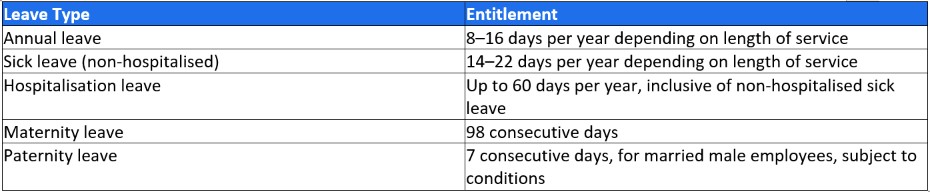
Leave Entitlements at a Glance
Flexible Working Arrangements
Employees may formally request changes to their working hours, days, or location under Sections 60P and 60Q of the Act. Employers must respond in writing within 60 days, either approving the request or giving business-based reasons for refusal. This is a process obligation, not an automatic right for the employee — but ignoring or indefinitely delaying a request is itself a compliance failure.
Sexual Harassment Provisions
Employers must display a visible, permanent notice raising awareness of sexual harassment in the workplace. On receiving a complaint, the employer must investigate within 30 days and inform the complainant of the outcome. Failure to investigate, or failure to provide required written explanations, can attract penalties of up to RM50,000.
A Practical Compliance Checklist
- Confirm every employee — regardless of salary — receives an itemised payslip each pay period.
- Audit working hours against the 45-hour weekly maximum and correct any rosters still built on 48 hours.
- Set payroll cut-offs with enough buffer to guarantee payment within 7 days of period end.
- Display the sexual harassment awareness notice in a visible, permanent location.
- Have a documented process for flexible working arrangement requests, including the 60-day response clock.
- Cross-check leave balances against the current entitlement table, particularly for employees near length-of-service thresholds.
Where Software Helps
Most Employment Act breaches are not deliberate — they are the result of manual leave tracking, outdated roster templates, or payslips generated from a spreadsheet template nobody updated after the last amendment. AI HCM generates compliant itemised e-payslips automatically, tracks leave entitlement by length of service, and flags overtime calculated on the current 45-hour standard. Book a free demo to see your current process against the 2026 requirements.
Disclaimer: This article is for general information only and is not legal, tax or professional advice. Statutory rates, rules and product specifications in Malaysia can change. The information is accurate as of the date the article was published or last updated. Check the latest guidance from the relevant authority, or speak to a qualified adviser or our team, before making decisions.